7 Business Mistakes Killing Your Growth (And How to Fix Them)
On this page (10 sections)
- 1. Ignoring Data and Making Emotional Decisions
- 2. No Clear Brand Positioning
- 3. Poor Online Presence
- 4. Not Using AI and Automation
- 5. Weak Marketing Strategy
- 6. Cash Flow Mismanagement
- 7. Trying to Do Everything Alone
- Final Thoughts: How to Avoid These Business Mistakes in 2026
- Frequently Asked Questions
- List Your Business on Nearif and Reach Verified Local Customers
Running a business in 2026 is more competitive than ever. Customers expect fast answers, smooth digital experiences, and clear value. At the same time, AI automation and algorithm-driven discovery have raised the baseline: businesses that operate without systems can lose momentum even when they’re working hard.
The tricky part is that growth rarely stops because of one big failure. It usually slows due to small, repeated business mistakes—weak measurement, unclear positioning, inconsistent marketing, or poor cash flow discipline. These issues don’t always look urgent day to day, but they silently block scale.
This guide breaks down the 7 most common business mistakes limiting growth in 2026 and gives you practical fixes you can implement within weeks—not months.
How to use this guide
Skim the headlines first, then pick the 1–2 mistakes that feel most familiar. Apply the checklists, set a weekly review routine, and track results for 30 days.

1. Ignoring Data and Making Emotional Decisions
If you don’t measure it, you can’t reliably improve it—especially in 2026’s fast-moving market.
The mistake
Many business owners still rely on gut feelings, anecdotes, or last month’s “vibe” to make decisions. Intuition can be useful, but in 2026 it becomes risky when it replaces measurement. Without data, teams often:
- Scale the wrong marketing channel because one post performed well
- Over-invest in features customers don’t value
- Keep spending on ads that look busy but don’t convert
- Misjudge pricing because feedback comes from a small, biased group
What it looks like in real life
- You cannot clearly answer: “Which channel brings our best customers?”
- Decisions are made in meetings without numbers on the screen
- Marketing reports focus on impressions and likes, not leads and revenue
- You change strategy frequently because results feel inconsistent
How to fix it
Start small: pick a few metrics that directly influence growth, review them weekly, and create a habit of testing one change at a time.
- Track core KPIs weekly: revenue, leads, conversion rate, customer acquisition cost (CAC), lifetime value (LTV), churn/refunds.
- Use one source of truth: GA4, a CRM dashboard, and a simple spreadsheet to connect leads to outcomes.
- Build a “decision rule”: decide in advance what happens if a metric moves up or down (example: “If CAC increases 20% for 2 weeks, we pause that campaign.”).
- Run short experiments: test headlines, offers, landing pages, or follow-up sequences in 7–14 day cycles.
- Review last 7 days: leads, sales, conversion rate, CAC
- Identify one bottleneck: traffic, conversion, or follow-up
- Choose one fix to test this week
- Document what changed and what happened
Practical tip
Keep a “metrics-to-action” note. Numbers alone don’t help—only decisions do. Every metric review should end with one specific action for the next 7 days.

2. No Clear Brand Positioning
When your message is vague, customers hesitate. Clear positioning reduces confusion and increases conversion.
The mistake
Trying to serve everyone typically leads to generic messaging. If customers can’t quickly understand what you do and why you’re different, they scroll past and choose a competitor with clearer positioning.
In 2026, attention is expensive. Your positioning must be instantly understandable across your website, ads, social profiles, and sales conversations.
Signs your positioning is weak
- Your homepage could belong to almost any business in your industry
- Prospects ask basic questions you thought were obvious
- Price becomes the main focus because value isn’t clear
- You rely heavily on discounts to win sales
How to fix it
Strong brand positioning answers three questions in one clear line: who you help, what problem you solve, and what result you deliver.
- Define your ideal customer profile (ICP): industry, size, budget range, and the specific pain you solve.
- Write a clear value proposition: “We help [customer] achieve [result] using [unique method].”
- Choose a category and a “point of difference”: speed, specialization, outcomes, premium quality, local expertise, or automation.
- Make your messaging consistent: same promise on website, ads, landing pages, and proposals.
Example positioning statement
Instead of “We provide digital services,” use “We help local businesses generate qualified leads using AI-powered marketing and conversion-focused landing pages.”
- Can a customer understand what you do in 5 seconds?
- Is the target customer clearly named (not “everyone”)?
- Does your message highlight a specific result (not just a feature)?
- Is there one clear differentiator (not a list of everything)?
3. Poor Online Presence
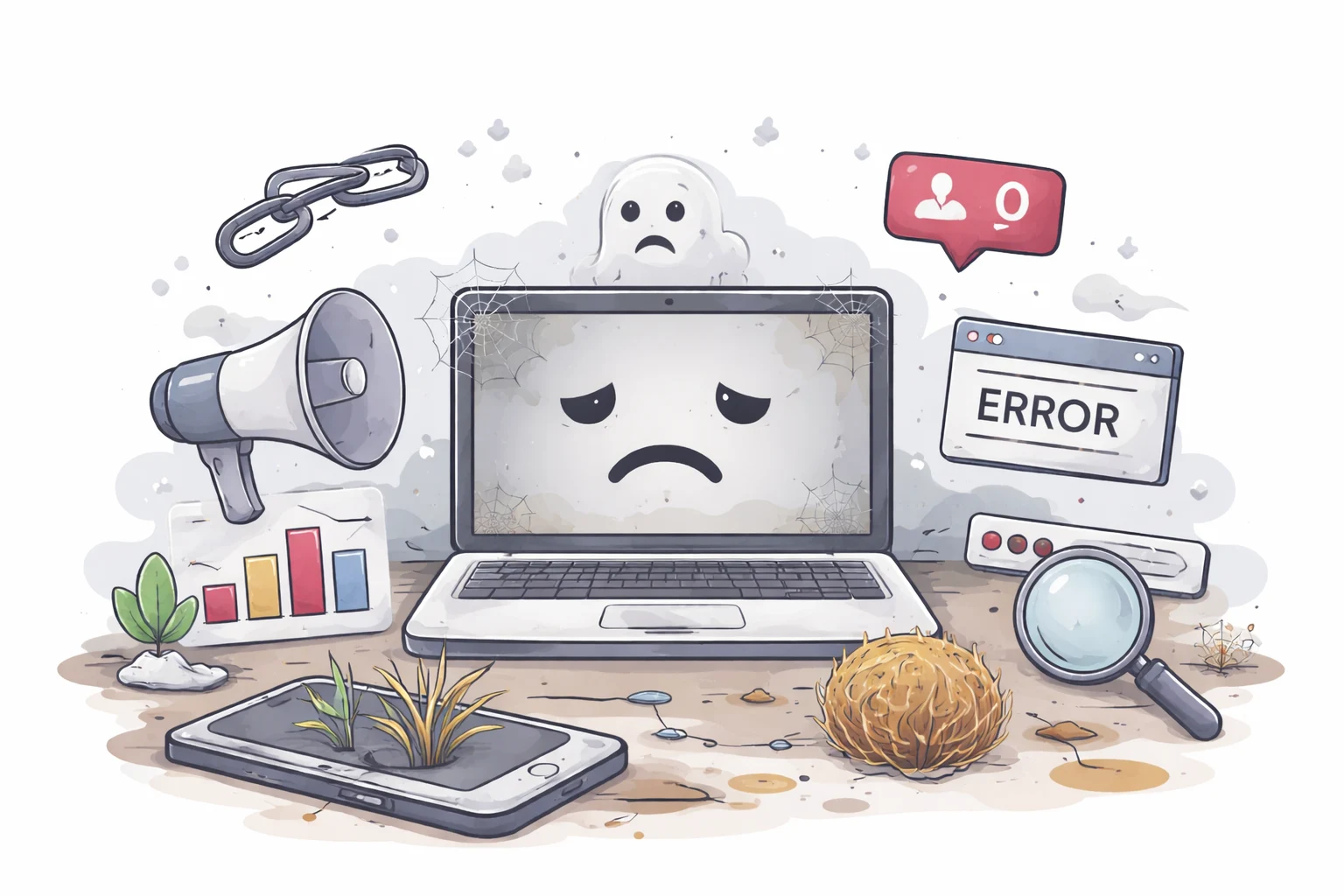
In 2026, visibility is survival. If customers can’t find or trust you online, growth slows—no matter how good you are.
The mistake
Many businesses still treat their website and search visibility as “nice to have.” But today, your online presence is often the first sales conversation customers have with you. Common problems include:
- Outdated pages that don’t match what you actually offer
- Slow mobile experience, confusing navigation, or broken forms
- No SEO strategy beyond a few keywords
- Weak proof: few reviews, no case studies, no trust signals
How to fix it
Think of your online presence as a growth asset. It should attract the right traffic, build trust fast, and convert visitors into leads.
- Improve speed and mobile usability: compress images, remove heavy scripts, simplify layouts, and ensure forms are frictionless.
- Publish SEO content consistently: answer real customer questions, target long-tail search intent, and update old posts.
- Strengthen local visibility: optimize your Google Business Profile, add services, post updates, and collect reviews.
- Add trust builders: testimonials, short case studies, guarantees, certifications, and clear contact details.
SEO in 2026
SEO still works best when content is genuinely helpful. Focus on intent-driven topics, clear headings, fast pages, and strong credibility signals.
- A fast mobile site with clear CTAs (call-to-action)
- Service pages that match exactly what you sell
- Reviews/testimonials visible on key pages
- Weekly content plan targeting customer questions
- Simple lead capture: form, booking link, or call button

4. Not Using AI and Automation
In 2026, AI is a multiplier. If you avoid it entirely, you often lose speed, margin, and consistency.
The mistake
Many business owners delay AI adoption because they think it’s complex, risky, or “not needed yet.” The result is that they keep doing repetitive work manually—support replies, follow-ups, reporting, scheduling, and content production—while competitors automate and move faster.
What AI should actually do for your business
AI is most valuable when it saves time on repetitive tasks, improves response speed, and supports decision-making. It does not need to replace your brand voice or remove human service. It should make your team more effective.
How to fix it
- Customer support: add a simple chatbot for FAQs, routing, and lead capture (with a clear handoff to a human).
- Sales follow-up: automate reminders, abandoned checkout recovery, and lead nurturing sequences.
- Content workflows: use AI to create outlines, FAQs, meta descriptions, and content briefs (then polish with human editing).
- Operations: automate repetitive admin tasks (invoicing reminders, onboarding emails, task routing).
- Analytics: use AI summaries to spot trends and anomalies in weekly reports.
- Pick the most repetitive task your team does daily
- Automate it with a simple trigger-action workflow
- Measure time saved and error reduction for 14 days
- Then move to the next repetitive workflow
Important
Use AI to improve speed and consistency, but keep human oversight where quality and trust matter (sales calls, complex support, strategy, and final approvals).

5. Weak Marketing Strategy
Random marketing creates random results. A simple system creates predictable growth.
The mistake
Many businesses post inconsistently, run ads without a clear funnel, or rely on one channel that can change overnight. This leads to unstable revenue, low conversions, and a constant cycle of panic posting.
What a strong 2026 marketing system looks like
A strong marketing strategy is a repeatable process that turns attention into leads and leads into sales. It doesn’t have to be complicated. It just needs consistency and measurement.
How to fix it
- Traffic: choose 1–2 primary channels (SEO + one of social/ads/partnerships).
- Lead capture: build a focused landing page with one offer and one main CTA.
- Nurture: follow up with email sequences, remarketing, or a simple content drip.
- Conversion: make buying easy with clear pricing, clear next steps, and fast response time.
High-impact improvements most businesses ignore
- Offer clarity: fewer options, clearer outcomes, and a stronger guarantee.
- Follow-up speed: responding within minutes often lifts conversion more than spending more on ads.
- Retargeting: many visitors need multiple touches before buying—use simple remarketing.
- Message match: ads and landing pages must promise the same result in the same words.
Consistency wins
Virality is unpredictable. A predictable system—content, landing pages, follow-up, and conversion—compounds every month.
- One main offer (clear outcome, clear target customer)
- One landing page (single CTA, minimal distractions)
- One nurture sequence (5–7 emails or messages)
- One conversion path (book, buy, call, or checkout)
- Weekly tracking (traffic, leads, conversion rate, CAC)

6. Cash Flow Mismanagement
Profit on paper doesn’t guarantee survival. Cash flow keeps the business alive long enough to grow.
The mistake
Many businesses fail because of cash flow problems rather than a lack of customers. Growth often increases complexity: more expenses, more staff, more tools, more refunds, longer payment cycles. Without a system, cash becomes unpredictable.
Common cash flow traps
- Overspending after a “good month” without forecasting
- Late invoicing and weak payment reminders
- No emergency buffer for slow seasons
- Too many subscriptions and tools that don’t produce ROI
- Pricing that doesn’t cover true delivery costs
How to fix it
- Build a cash buffer: aim for a reserve that covers operating costs (start with 1 month, then grow it).
- Track weekly: cash in, cash out, upcoming bills, and receivables.
- Automate invoicing: recurring invoices, reminders, and late-payment follow-ups.
- Forecast quarterly: project revenue conservatively and plan expenses accordingly.
- Know your margins: calculate delivery cost per product/service and adjust pricing if needed.
- Current cash balance and runway
- Invoices due this week and next
- Top 5 expenses and what can be reduced
- Forecast revenue for the next 30 days
- One action: collect faster, reduce waste, or increase margin
Rule of thumb
Protect cash flow first. Fast growth is great, but stable cash flow is what makes growth sustainable.

7. Trying to Do Everything Alone
If the business depends on the owner for everything, it cannot scale without burning out.
The mistake
Entrepreneurs often carry too much—marketing, sales, delivery, admin, customer support, hiring, and finance. In the short term, it feels efficient. In the long term, it becomes a ceiling. You become the bottleneck.
Where this shows up
- You delay launches because you don’t have time
- Quality drops when workload increases
- You can’t take time off without operations slowing down
- Opportunities are missed because you’re stuck in daily tasks
How to fix it
Delegation is not about giving away control. It’s about creating repeatable systems so the business can run without constant owner intervention.
- List tasks by value: keep high-value leadership tasks (strategy, partnerships, key sales) and delegate low-value repetitive work.
- Document processes: create simple SOPs for common tasks (checklists, templates, short videos).
- Outsource specialized work: design, advanced ads, SEO technical fixes, bookkeeping, or automation setup.
- Hire for outcomes: define what success looks like (response time, leads booked, tickets resolved) before hiring.
- Pick one repetitive task to delegate this month
- Create a short SOP (steps + example + definition of done)
- Assign ownership and set a weekly check-in
- Improve the SOP based on real feedback
Growth principle
Businesses scale when the owner focuses on leadership and systems—not when the owner becomes the “super employee.”
Final Thoughts: How to Avoid These Business Mistakes in 2026
Business growth in 2026 is not about working harder. It’s about building a business that runs on clarity, systems, and measurable improvement.
When you combine data-driven decisions, strong brand positioning, a credible online presence, smart AI automation, a consistent marketing funnel, cash flow discipline, and a delegation mindset, growth becomes more predictable—and much less stressful.
2026 growth priorities to focus on next
- Clarity over complexity: one customer, one promise, one primary offer.
- Systems over chaos: simple weekly routines that drive results.
- Strategy over guesswork: measure, test, and improve.
Next step
Pick one mistake from this guide and commit to fixing it for 30 days. Small improvements compound quickly when you track results and stay consistent.
Frequently Asked Questions
What is the biggest business mistake in 2026?
The biggest growth killer is usually a combination of weak measurement, poor digital visibility, and slow execution. Businesses that ignore data and avoid automation often struggle to compete with faster, more system-driven competitors.
How can small businesses grow faster in 2026?
Small businesses grow faster by doing a few fundamentals extremely well: clear positioning, SEO-driven content that matches user intent, a simple funnel, quick follow-up, and automation for repetitive tasks.
Is SEO still effective in 2026?
Yes. SEO remains one of the highest-ROI channels when your content is helpful, your pages load fast, your structure is clear (headings, internal organization), and your business demonstrates credibility through reviews and proof.
How do I know which mistake is hurting my business the most?
Look for the bottleneck: if you have traffic but low leads, it’s conversion and positioning. If you have leads but low sales, it’s follow-up and offer clarity. If revenue is unstable, it’s often weak marketing systems or cash flow management.
What should I automate first?
Start with follow-up and support. Automating lead replies, appointment reminders, and common FAQs typically improves conversion quickly because it reduces delays and improves customer experience.
List Your Business on Nearif and Reach Verified Local Customers
Get discovered by nearby customers, build trust with a verified profile, and grow your business locally.
Found this useful? Pass it on
More inTips and Tricks