Business Registration in Nepal: Documents, Process & PAN Guide

On this page (17 sections)
- What Is a Small Business in Nepal?
- Examples of Small Businesses in Nepal
- Why Should You Register a Small Business in Nepal?
- Key Benefits of Registration
- Which Authorities Register Small Businesses in Nepal?
- Step-by-Step Registration Process in Nepal
- List Your Newly Registered Business on Nearif — For Free
- Documents Required for Small Business Registration in Nepal
- Main Documents
- Additional Supporting Documents
- How Long Does It Take to Register a Small Business in Nepal?
- Practical Tips Before Registering Your Small Business
- Common Mistakes to Avoid
- Do You Need Legal Help for Business Registration in Nepal?
- FAQ: Small Business Registration in Nepal
- Final Thoughts
- Registration Done? Put Your Business in Front of Local Customers on Nearif
Starting a small business in Nepal is an exciting step, whether you are opening a local shop, home-based business, service agency, café, boutique, or small manufacturing venture. But before you begin operations, one important step should never be skipped: official business registration.
What Is a Small Business in Nepal?
A small business generally refers to a privately owned business operated by an individual or a small group of people. These businesses usually have limited investment, fewer employees, lower annual revenue compared to large companies, and local or regional operations.
Examples of Small Businesses in Nepal
Small businesses play a major role in Nepal's economy by generating employment, supporting local communities, and encouraging entrepreneurship.
Why Should You Register a Small Business in Nepal?
Many people start operating informally, especially for local shops or small service businesses. However, registering your business is strongly recommended and often necessary depending on the nature of your operation.
Key Benefits of Registration
Which Authorities Register Small Businesses in Nepal?
Depending on the type of business, small businesses in Nepal are commonly registered through one or more of the following offices:
Ward Office
If your business is a local shop, service business, or neighborhood-level operation, you can often register it through your local ward office. This is the most common starting point for small businesses.
Dept. of Cottage & Small Industries
If your business involves production, manufacturing, handicrafts, cottage industries, or entrepreneurial product development, registration may also be done through the Department or Office of Cottage and Small Industries.
Inland Revenue Department (IRD)
After registration, businesses usually need to obtain a PAN (Permanent Account Number) from the Inland Revenue Department for tax and financial purposes.
A small business can also be registered as a company in Nepal. However, for very small or local businesses, a simpler registration route through the ward office is often enough at the start. Company registration becomes more relevant if you plan to scale nationally, bring in partners, or create a more formal business structure.
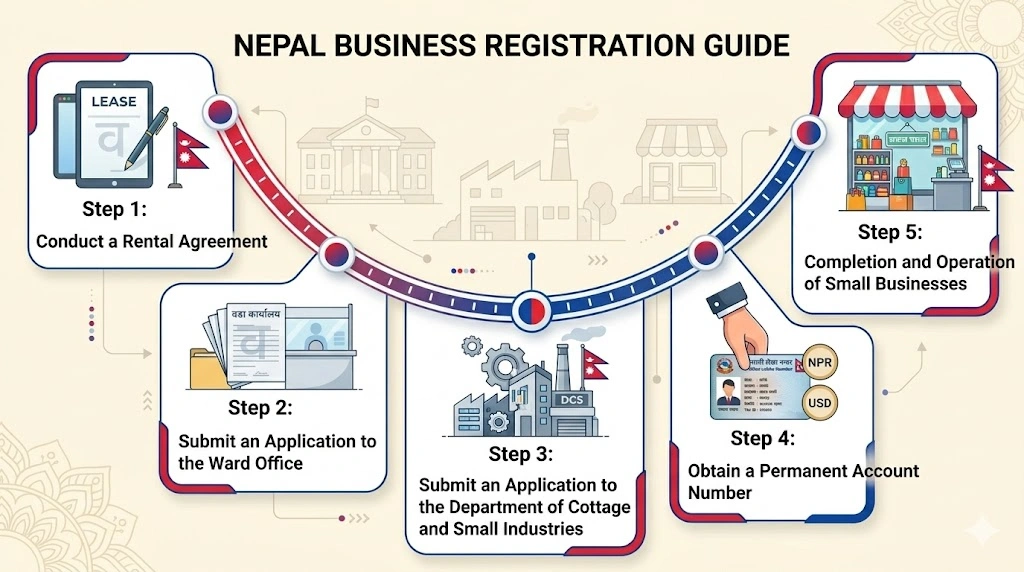
Step-by-Step Registration Process in Nepal
Below is the most practical and commonly followed process for registering a small business in Nepal.
Prepare a Rental Agreement (If Applicable)
Before applying for registration, prepare a rental agreement if your business operates from a rented space. This agreement is between the house/shop owner and the business owner. It proves your business is legally operating from that location and may be required during registration or while obtaining a PAN. If running from your own property, you may need property-related documents instead.
Apply at the Ward Office
Submit your business registration application to the ward office where your business is physically located. Your application should include: business name, type of business, nature of services or products, business location, owner's details, and contact information. The ward office will review and, if approved, issue a registration certificate or local recommendation. Best for shops, local service providers, small stores, and independent traders.
Register with Cottage & Small Industries (If Required)
If your business falls under small industry, cottage industry, handicraft, production, or manufacturing, you may also need to apply to the Department of Cottage and Small Industries. This is especially relevant for businesses involved in product manufacturing, handmade goods, local production units, small-scale processing, or entrepreneurial product development. This step may not apply to every small business.
Obtain a PAN (Permanent Account Number)
Once registered, obtain a PAN from the Inland Revenue Department (IRD). A PAN is essential for tax registration, invoicing, financial transactions, opening business accounts, and compliance. Without a PAN, your business may face limitations when dealing with suppliers, financial institutions, tax filings, and formal contracts.
Start Operating Legally
Once you complete the required registrations and obtain the necessary documents, your business is ready to operate formally and legally. You are now in a stronger position to attract customers confidently, work with vendors and partners, manage finances properly, and expand in the future.
List Your Newly Registered Business on Nearif — For Free
Once your business is registered in Nepal, the next step is visibility. Nearif helps local customers find and trust your business with a verified profile — no technical skills required.
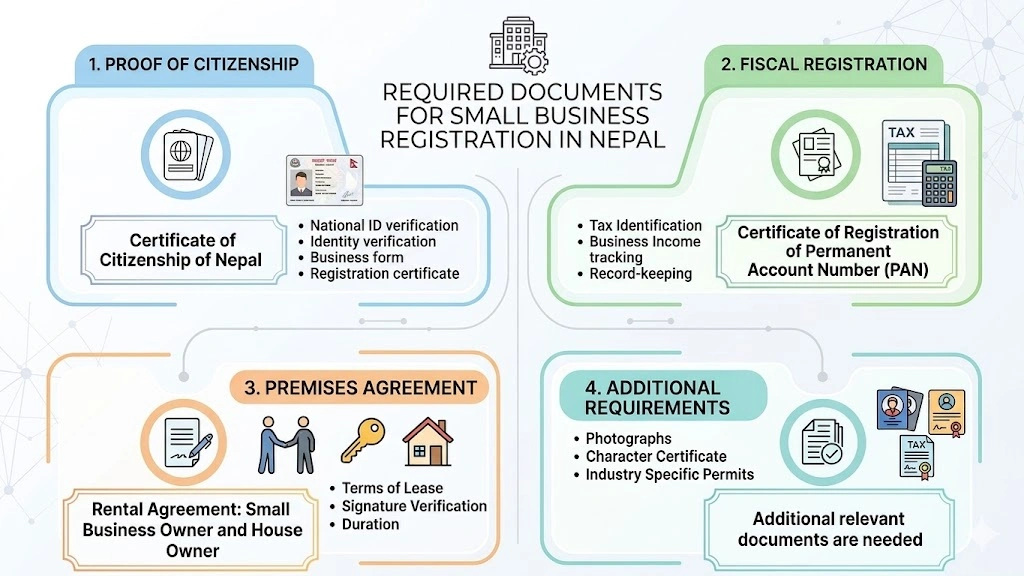
Documents Required for Small Business Registration in Nepal
The following are the commonly required documents for registering a small business in Nepal. Requirements may vary slightly by location and office.
Main Documents
Additional Supporting Documents
Since document requirements can vary by location and business type, it is always smart to confirm with the local ward office or relevant department before applying.
How Long Does It Take to Register a Small Business in Nepal?
In many cases, a small business in Nepal can be registered within a few days to about one week, depending on document readiness, office workload, business type, and location and municipality procedures.
Practical Tips Before Registering Your Small Business
Finalize Your Business Name
Choose a business name you want to use consistently across signage, invoices, and registration records. Changing it later creates complications.
Decide Your Business Category Clearly
Know whether your business is retail, service-based, online, food-related, manufacturing, or a cottage industry. This determines where you need to register and what documents are required.
Prepare All Documents in Advance
Keep multiple photocopies and digital scans of your citizenship, rental agreement, passport photos, address proof, and PAN documents before visiting any office.
Confirm Requirements Locally
Ward offices and local authorities may ask for slightly different supporting documents, so it is always wise to check directly before visiting rather than assuming.
Keep Everything Organized
Maintain a folder with your registration certificate, PAN certificate, agreements, tax records, and receipts. This will be essential for future renewals or legal procedures.
Common Mistakes to Avoid
Many first-time business owners delay registration or make simple mistakes that create unnecessary complications later.
Starting operations without proper local registration · Not preparing a rental agreement · Using incomplete or inconsistent business information · Ignoring PAN registration · Not checking which office your business falls under · Waiting until tax or legal issues arise. A little preparation at the beginning can save a lot of stress later.
Do You Need Legal Help for Business Registration in Nepal?
For many simple local businesses, the registration process can be straightforward. However, if your business involves multiple owners, manufacturing, licensing, food or health-related operations, legal agreements, investment planning, or formal business structuring — then professional legal or registration assistance can be helpful.
This is especially useful if you want to avoid mistakes, delays, or compliance issues later.
If you are serious about building a sustainable and trusted business in Nepal, registration should never be treated as optional — it is part of setting your business up the right way.
FAQ: Small Business Registration in Nepal
Final Thoughts
Registering a small business in Nepal is one of the smartest first steps for any entrepreneur. It not only helps you operate legally, but also gives your business a stronger foundation for future growth.
In simple terms, the process usually includes: preparing a rental agreement, applying at the ward office or relevant industry office, obtaining a PAN, and organizing the required documents properly.
The key to a sustainable business in Nepal starts with doing things the right way — registration is where that journey begins.
Registration Done? Put Your Business in Front of Local Customers on Nearif
You've taken the right first step by registering your business. Now make sure local customers can actually find you. Nearif gives your business a verified online presence — trusted by customers across Nepal.
Found this useful? Pass it on
More inNearif Guides